A dental implant is a screw-shaped part, usually made of titanium, placed in the jawbone in place of a missing tooth's root. Once it has fused with the bone, a connecting part called an abutment and a crown are fitted on top. From placement to fitting the final tooth usually takes 2-6 months, and longer if bone grafting is needed.
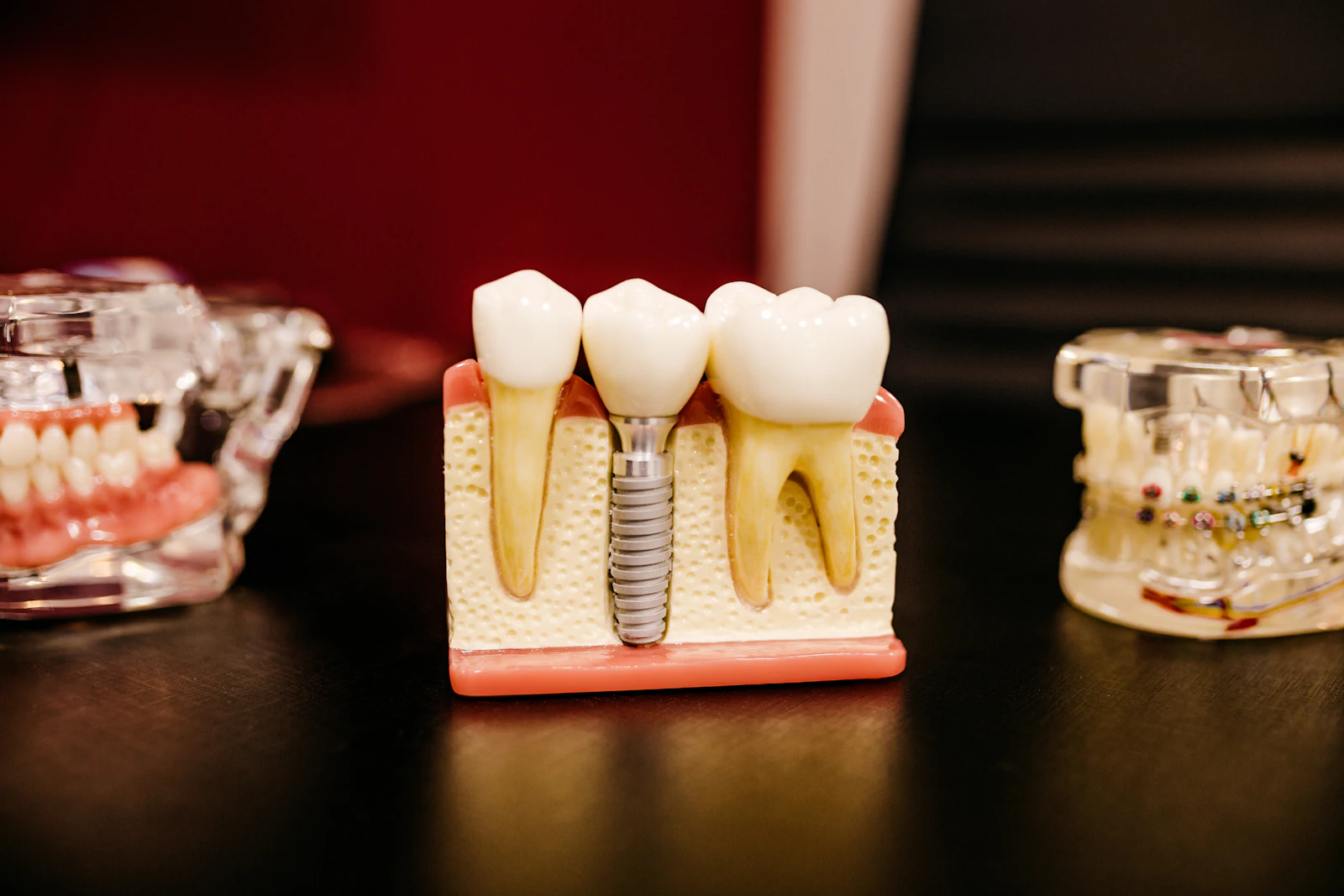
A dental implant is an artificial tooth root placed in the jawbone in place of a missing tooth's root. It is usually made of titanium and shaped like a screw. Once it has fused with the bone, a connecting part and the visible tooth, the crown, are fitted on top. It replaces a missing tooth without touching the neighbouring teeth. An implant can replace a single tooth, and several implants can carry a bridge or a fixed denture for a jaw with no teeth.
What parts does an implant have?
Although it looks like a single tooth in the mouth, an implant is made up of three separate parts.
- Implant body. The threaded part placed inside the bone. It does the job of a natural tooth's root. Its length and width are chosen according to the bone.
- Abutment. The connecting part screwed into the implant body, which comes out through the gum. The crown sits on it.
- Crown. The tooth you see in your mouth. It is usually made of zirconia or porcelain, and its colour is matched to the neighbouring teeth.
In some systems, the abutment and crown are made as a single piece and screwed into the implant. Which method is chosen depends on the position of the tooth and the aesthetic expectations.
This multi-part design has a benefit: if the crown wears or breaks years later, the top part alone can be replaced without removing the implant.
What are implants made of?
The vast majority of implants are made of titanium or a titanium alloy. Titanium is compatible with the body, and bone cells can attach to its surface. This fusion is called osseointegration. Implant surfaces are also specially treated so bone attaches better.
A less commonly used option is the zirconia implant. It contains no metal and is white. It may be considered for patients with thin gums and high aesthetic concerns in the front of the mouth, or for those who want to avoid metal. However, long-term data on zirconia implants is more limited than for titanium, and their range of use is narrower. They may not be the right choice in every case.
Who is it suitable for, and who not?
Almost anyone whose jaw has finished growing, whose general health is good and who has enough bone to hold an implant, or whose bone can be built up, can be a candidate. There is no upper age limit. Among patients who come to us for dental implants in Trabzon, older people are not rare. In a healthy patient, age alone is not a barrier.
Some situations call for careful assessment or postponement:
- Young people whose jaw is still growing (usually before age 18)
- People with diabetes whose blood sugar is not under control
- People who have had radiotherapy to the head and neck
- Those who have had bisphosphonates into a vein for bone loss or cancer treatment
- Patients receiving active chemotherapy
- Pregnant women (treatment is usually postponed until after birth)
- Heavy smokers and people with poor oral hygiene
Being on this list does not always mean an implant is impossible. We can only make the right decision after an examination, tests where needed and a conversation with your other doctors.
Treatment stages and timing
The table below shows a typical case where no extra procedures are needed. Times vary from person to person; they are given only as a guide.
| Stage | What is done | Approximate time |
|---|---|---|
| Examination and planning | Oral examination, panoramic X-ray and, when needed, a 3D CT scan. The position, length and number of implants are planned. | 1-2 sessions |
| Preliminary treatment (if needed) | Tooth extraction, gum treatment, bone grafting or a sinus lift | A few weeks to a few months |
| Placing the implant | Under local anaesthetic, the implant body is placed in the bone and stitches are put in. | Usually 30-60 minutes for a single implant |
| Stitch removal | The wound is checked and the stitches are removed. | 7-14 days later |
| Healing | The implant fuses with the bone. A temporary solution can be used during this time. | 2-3 months in the lower jaw, 3-6 months in the upper jaw |
| Impressions and try-in | The abutment is fitted, impressions are taken and the crown is tried in. | 1-3 sessions, over a few weeks |
| Fitting the crown | The final tooth is fixed in place and the bite is checked. | 1 session |
| Check-ups | Gum and bone levels are monitored. | Every 6-12 months |
In some patients with suitable bone and general health, a temporary tooth can be fitted on the same day the implant is placed. This is called immediate loading. It is not right for every case; the decision depends on the quality of the bone and how firmly the implant holds at first.
If you live abroad or are visiting Trabzon, note that the healing stage alone takes months, so implant treatment usually cannot be completed in a single short trip. It is best to talk through the visit plan with your dentist before starting.
Daily life during treatment
Most people can go back to work the day after implant surgery. If you do heavy physical work, or if several implants and bone grafting were done, resting for a day or two helps. To avoid a visible gap during healing, a temporary tooth or a removable interim denture is usually used at the front. At the back, sometimes no temporary solution is needed. During these months you will be asked to avoid chewing hard food on the implant side. You brush your teeth as usual, just gently around the surgical area.
Implants for a single tooth, a bridge or a whole jaw
A single missing tooth
This is the simplest scenario. One implant is placed in the gap with a crown on top. Unlike a bridge, the neighbouring teeth do not have to be cut down. Which option suits you is decided at the examination.
Several missing teeth
If several teeth in a row are missing, you may not need a separate implant for each one. For example, a three-tooth bridge on two implants may be planned for three missing teeth. This is decided by the bone and the chewing forces.
A jaw with no teeth
For a jaw with no teeth at all, there are two main approaches. The first is a removable denture held on two or four implants with press-stud or bar attachments. The denture is taken out for cleaning but sits much more firmly than a conventional denture.
The second is fixed solutions. The best known is the approach called all-on-4: four implants, sometimes with the back ones placed at an angle, support a fixed bridge carrying the whole jaw. Angled placement can reduce the need for bone grafting in some patients. Depending on the bone, there are also fixed dentures on six or more implants. Which one is suitable is decided by looking at the amount of bone, the teeth in the opposite jaw and the patient's expectations together.
Bone grafting and sinus lift
After a tooth is extracted, the bone in that area slowly shrinks. Where a gap has been left empty for a long time, there may not be enough bone to hold an implant. In that case the bone is built up with bone graft material, sometimes in the same session as the implant and sometimes a few months before.
In the back of the upper jaw, above the molars, there is the sinus cavity. After teeth are extracted, this cavity can expand downwards. A sinus lift gently raises the sinus membrane and places bone graft material underneath to make room for the implant. Both procedures lengthen treatment, but where they can be done, they make an implant possible.
Risks
When well planned, implant treatment has a high success rate. Still, like any surgical procedure, it has risks you should know about.
- Swelling, bruising and tenderness in the first days. These usually pass within a few days.
- Infection. Good oral hygiene and following your dentist's advice lower the risk.
- The implant failing to fuse with the bone. This is uncommon; when it happens, the implant is removed and can be tried again once the area has healed.
- Numbness of the lip or chin when working near the nerve in the lower jaw. This is rare, and a CT scan at the planning stage reduces the risk.
- A tear in the sinus membrane in the upper jaw.
- In the long term, peri-implantitis, which is inflammation of the gum and bone around the implant.
Lifespan and care
You have the biggest say in how long an implant lasts. Implants that are well cared for and checked regularly can be used without problems for many years. The crown on top may wear over the years with use and can be replaced.
Care is not very different from a natural tooth. Brushing twice a day, cleaning between the implant and the neighbouring tooth with an interdental brush or floss, and a check-up every 6-12 months are enough. If you clench your teeth at night, a night guard protects both the implant and the crown. Smoking speeds up bone loss around implants, so stopping is the best choice. If you notice bleeding gums, swelling around the implant or a bad taste, do not wait for your check-up.
If you are considering implants, we explain how to prepare for the examination in our tips for anyone considering dental implants article. You can find how implant treatment works at our Trabzon dental clinic on the dental implants page, and what affects the cost in what dental implant costs depend on.
Frequently asked questions
Does a dental implant hurt?
Because the implant is placed under local anaesthetic, you usually feel no pain during the procedure, only pressure and vibration. For a few days afterwards there may be tenderness and mild swelling, which most people manage with painkillers.
How long does implant treatment take?
Where no extra procedures are needed, usually 2-6 months pass between placing the implant and fitting the final tooth. If a bone graft or sinus lift is needed, this can take a few months longer.
How many years does an implant last?
Implants that are well cared for and checked regularly can stay in the mouth for many years. The crown on top may need replacing over the years due to wear. Smoking, gum disease and poor oral hygiene shorten an implant's life.
Who cannot have dental implants?
Implants are postponed in young people whose jaw is still growing. Uncontrolled diabetes, radiotherapy to the head and neck, bisphosphonates given into a vein and active cancer treatment need careful assessment. The final decision is made at the examination.
Zirconia or titanium implants?
Titanium implants have been used for a very long time and there is extensive scientific data on them. Zirconia implants contain no metal and may be preferred for appearance, but they do not suit every case. The bone and the position of the tooth decide the choice.
What does the cost of an implant depend on?
It depends on the implant system used, the number of implants, extra procedures such as bone grafting and the type of tooth placed on top. Accurate information can be given after an examination and any imaging needed.

Written and reviewed by: Dt. Ahmet Alper Güler
Dentist in Trabzon. Last updated: November 16, 2026. This article is general information; the right treatment for you is decided after an examination.
Book an examination
Call us or choose a time that suits you in the online booking system.